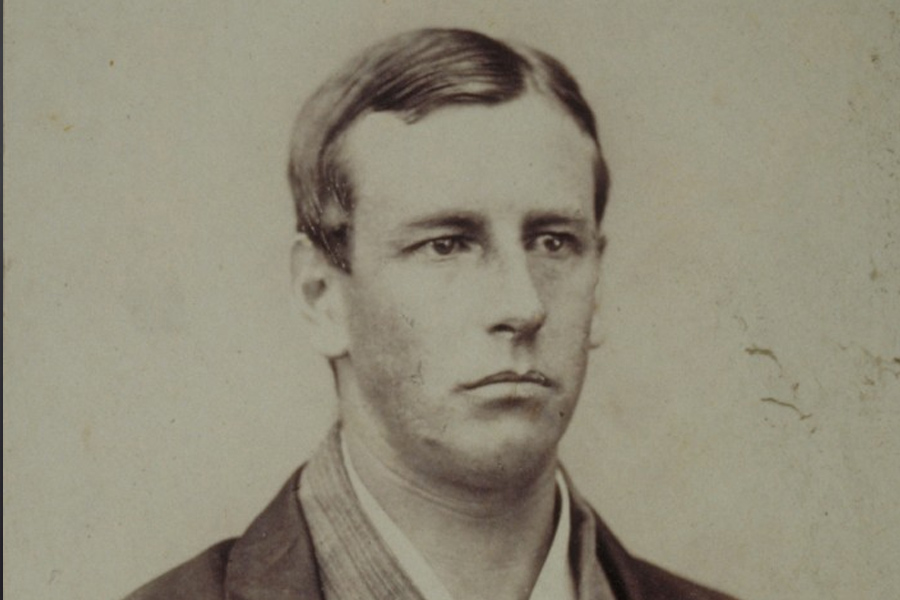
Basic Information
| Field | Details |
|---|---|
| Full name | Charles Appleton Longfellow |
| Nickname | Charley |
| Birth | June 9, 1844, Cambridge, Massachusetts |
| Death | April 13, 1893, Portland, Maine |
| Parents | Henry Wadsworth Longfellow and Frances “Fanny” Appleton Longfellow |
| Siblings | Ernest Wadsworth; Alice Mary; Edith; Anne Allegra (plus infant sister Fanny, deceased) |
| Marital status | Never married |
| Children | None |
| Military service | Union Army, 1863; Private, Battery A, 1st Massachusetts Light Artillery; Second Lieutenant, 1st Massachusetts Cavalry |
| Notable for | Civil War wound connected to his father’s poem “Christmas Bells” (“I Heard the Bells on Christmas Day”); extensive travels and collecting, especially in Japan |
| Burial | Mount Auburn Cemetery, Cambridge, Massachusetts |
From Cambridge Boyhood to War
Born into one of 19th-century America’s most famous literary households, Charles Appleton Longfellow grew up in a home of books, music, and conversation, where distinguished visitors were common and curiosity was a family value. The bright, happy cadence of his early years faltered in 1861 when his mother died tragically in a household fire, a loss that reshaped the family’s emotional landscape and left deep impressions on the teenage Charley.
At nineteen, Charley asserted his independence in dramatic fashion. In March 1863 he left home without his father’s consent and enlisted as a private in Battery A, 1st Massachusetts Light Artillery. Within weeks, on April 1, he was commissioned a second lieutenant in the 1st Massachusetts Cavalry, a rapid elevation reflecting both family influence and his own determination. He stood with the Union during the Chancellorsville campaign, experienced the grinding attrition of cavalry skirmishes around Culpeper, and battled illness—malaria struck in June 1863, a common scourge in the camps.
The pivotal date came on November 27, 1863, at the Mine Run Campaign in Virginia. A bullet tore through his left shoulder and back, a grave wound that sent dispatches racing to Cambridge. Henry Wadsworth Longfellow hurried to his son’s side and brought him home to recover, the poet’s anguish later distilled into the 1863 poem “Christmas Bells,” known to the world through the carol “I Heard the Bells on Christmas Day.” Military doctors eventually declared Charley unfit for further service, ending his formal wartime chapter before his twentieth birthday.
Roads of the World: Travels and Collecting
After the war, Charley exchanged the regimented life of the army for the boundless map of the world. He recovered abroad and never really stopped moving. Over the next two decades he stitched together an itinerary that reads like the logbook of a clipper ship: Europe, India, East Asia, the Pacific, and the Caribbean. Travel, rather than any office or profession, became his vocation.
His roughly two-year stay in Japan—then open to the West—was formative. He learnt the language and culture, travelled northern regions rarely visited by Westerners, and made acquaintances in Yokohama and Tokyo. He carefully selected textiles, prints, weaponry, lacquerware, and pictures, sending crates home to fill American museums and his family mansion. He enthusiastically pursued local hobbies like fencing, theatre, and full-body tattooing, demonstrating his desire to bridge cultural boundaries rather than simply watch them. He was introduced to Emperor Meiji, a minor but crucial indicator of his deep involvement in Japan’s transitional period.
India also claimed him—fifteen months across 1868–1869—where hill stations, temple cities, and the Himalayas populated his journals and albums. Between voyages he returned periodically to Cambridge, checked in on family, and headed out again, trading drawing rooms for docks and ship cabins.
Selected Travel Timeline
| Years | Regions/Destinations | Highlights |
|---|---|---|
| 1864 | Europe | Post-war convalescence and first long tour abroad |
| 1868–1869 | India | ~15 months; Himalayan excursions; voluminous photo and sketch albums |
| 1871–1873 | Japan (with travel in China and the Philippines) | Nearly 2 years; deep cultural immersion, collecting, and court presentation |
| 1875–1891 | Caribbean, Mexico, North Africa, the Levant, Europe, Scandinavia, Iberia, Australia | Serial voyages; journals, photographs, and acquisitions for home and museums |
Numbers tell their own tale: a military career measured in months, and a traveler’s life measured in years; nearly twenty years of serial wandering, with multiple continents underfoot and a collection that grew by the trunk-load. For Charley, the world was not a backdrop but a workshop.
Family Constellation
Charley’s story unfolds within a constellation of notable relatives whose gifts—literary, industrial, religious, and artistic—contributed to a broad New England legacy.
- His father, Henry Wadsworth Longfellow (1807–1882), stood at the apex of American letters, his poems memorized across the country. A devoted parent, he nonetheless opposed Charley’s enlistment; love and worry clashed in that season.
- His mother, Frances “Fanny” Appleton Longfellow (1817–1861), brought wealth, refinement, and a fiercely affectionate presence to the household. Her accidental death fractured the family’s sense of safety and left Charley with a grief that wandered with him.
- Siblings carved distinguished paths: Ernest Wadsworth Longfellow (1845–1921) became a painter; Alice Mary (1850–1928) emerged as a philanthropist and preservationist; Edith (1853–1915) moved in Boston’s social world; Anne Allegra (1855–1934) helped steward the family legacy. The bond among them proved durable despite distance and time.
On the maternal side stood Nathan Appleton, the Boston industrialist whose mercantile and textile fortune underwrote opportunity and security. Among the uncles, Thomas Gold Appleton—cosmopolitan, wry, and unattached—offered a bachelor’s template Charley loosely followed. On the paternal side, the gentle reformist voice of the Reverend Samuel Longfellow provided another model of conscience and culture.
Key Family Figures
| Relative | Lifespan | Relationship | Notable points |
|---|---|---|---|
| Henry W. Longfellow | 1807–1882 | Father | Poet; opposed Charley’s enlistment; wrote “Christmas Bells” in 1863 |
| Frances “Fanny” Appleton | 1817–1861 | Mother | Heiress and cultural force; died in a household fire |
| Ernest W. Longfellow | 1845–1921 | Brother | Artist; shared periods of travel |
| Alice Mary Longfellow | 1850–1928 | Sister | Preservationist; stewarded family home and memory |
| Edith Longfellow | 1853–1915 | Sister | Married into the Dana family; Boston social circles |
| Anne Allegra Longfellow | 1855–1934 | Sister | Guarded the family legacy into the 20th century |
| Nathan Appleton | 1779–1861 | Grandfather (maternal) | Industrialist; emblem of New England wealth and enterprise |
| Samuel Longfellow | 1819–1892 | Uncle (paternal) | Unitarian minister and hymn writer |
Means and Motives
No ledger can tally Charley’s life as neatly as his father’s royalty statements. He had no formal career and left no business ledgers. Yet he traveled with the assurance of a man who knew that family means—literary success on one branch, industrial capital on another—formed a safety net. He bought saddles and swords, paid guides and shipmasters, acquired prints and photographs, and posted home crates marked with far port names. Wealth did not make him idle; it made him mobile.
Motivation is harder to audit. Independence tugged at him early. The battlefield convinced him of life’s fragility. The home’s grief, and the weight of a famous father’s presence, may have urged him outward. He chose the open road over public acclaim, a private ledger of days over the public’s gaze.
Legacy
Charley’s legacy is subtle but persistent. He appears in the margins of a famous poem via a battlefield wound. He populates museum labels as the original owner of a Japanese sword, a print, a lacquer box. He threads through the Longfellow House with albums, sketches, and souvenirs that turned rooms into miniature world’s fairs. He was no celebrity; he preferred the traveler’s quiet dignity. Yet his curiosity helped widen 19th-century America’s window on Asia, and his family’s memory kept his footprints from fading.
FAQ
Did Charles Appleton Longfellow marry or have children?
No; he never married and had no children.
What was his role in the Civil War?
He enlisted in 1863, served in artillery and cavalry units, and was severely wounded at Mine Run on November 27, 1863.
How did his injury connect to his father’s poetry?
His wounding formed part of the backdrop to Henry Wadsworth Longfellow’s 1863 poem “Christmas Bells,” later set as “I Heard the Bells on Christmas Day.”
Where did he travel after the war?
Across Europe, India (for about 15 months), and East Asia, with nearly two years in Japan from 1871 to 1873.
Did he really meet Emperor Meiji?
Yes; he was presented at court during his extended stay in Japan.
What did he collect abroad?
Japanese prints, arms, lacquerware, textiles, and photographs, along with travel journals and sketches.
Where is Charles Appleton Longfellow buried?
He is buried at Mount Auburn Cemetery in Cambridge, Massachusetts.
What kind of work did he do?
He avoided formal careers, choosing a life of travel, cultural study, and personal collecting supported by family means.